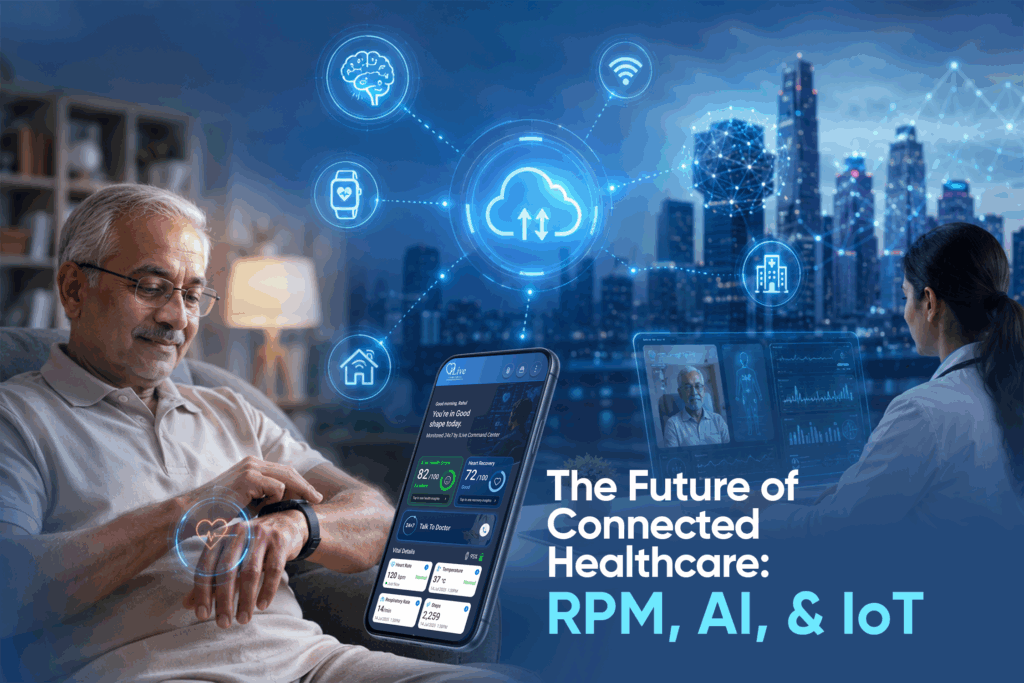
The traditional walls of healthcare are dissolving. A quiet revolution is shifting global medicine from reactive, hospital-based treatments to predictive, continuous care. This massive structural evolution relies on three technological pillars: Remote Patient Monitoring (RPM), the Internet of Things (IoT), and Artificial Intelligence (AI). Together, these AI Healthcare Monitoring systems are constructing a modern ecosystem where care is omnipresent, hyper-personalised, and remarkably proactive.
The physical foundation of this shift rests on the medical Internet of Things (IoT). These connected devices act as the sensory nervous system of modern healthcare. Clinical-grade smart wearables, subcutaneous glucose patches, and digital inhalers now stream continuous biometric data in real-time. Gone are the days of erratic, isolated clinic readings. Instead, medical professionals receive a flowing, dynamic chronicle of a patient’s actual lifestyle and internal health. Within hospital wards, smart beds and environmental IoT tags optimise clinical workflow. At home, ambient sensors track daily activity levels and medication adherence, ensuring that data collection in AI heart health monitoring India is passive, effortless, and deeply embedded within a patient’s routine.
However, continuous data generation is practically useless without sophisticated analysis. This is where Artificial Intelligence enters the ecosystem as the master translator. Raw streams of millions of vital statistics are completely overwhelming for human doctors to review manually. Advanced AI algorithms digest these massive data oceans instantly. They filter out ambient noise, recognise baseline trends, and pinpoint precise physiological anomalies. Machine learning models identify subtle trends that hint at upcoming cardiac events or severe glycemic drops hours before physical symptoms ever manifest. AI also fuels modern clinical decision support systems. By cross-referencing an individual’s data against vast global medical knowledge bases, the AI based health monitoring system helps clinicians formulate hyper-personalised treatment trajectories.
This powerful combination of IoT and AI finds its most practical application in Remote Patient Monitoring (RPM). RPM is fundamentally redefining chronic disease management and post-operative recovery frameworks. Patients living with complex conditions like congestive heart failure no longer live in fear of sudden relapses. Continuous biometric tracking transmits real-time alerts directly to centralised care teams if fluid retention levels begin to rise. This immediate insight allows for early, low-cost medication adjustments before emergencies occur. Consequently, expensive emergency room visits and distressing hospital readmissions drop sharply. Furthermore, RPM effectively solves the historic geographic lottery of healthcare access. Rural and homebound patients gain instant access to world-class speciality care without enduring taxing, expensive physical journeys.
Yet, this connected future is not without significant roadblocks. As deeply personal health data populates cloud networks, data privacy and regulatory compliance become paramount vulnerabilities. Cybersecurity frameworks must evolve rapidly to prevent dangerous breaches of sensitive medical infrastructure. Device interoperability remains another steep hurdle. Devices from different manufacturers must learn to speak a universal digital language to exchange data smoothly. Clinicians also face acute alert fatigue, highlighting the urgent need for smarter AI filtering tools that surface only critical, high-priority notifications.
Looking ahead, the integration of connected healthcare will become entirely invisible yet absolute. We are moving swiftly toward a reality where medical devices do not just report your current state, but actively predict and manage your long-term wellness. Prescriptions will automatically adjust based on real-time biometric loops, and hospital stays will be reserved only for acute emergencies. The fusion of RPM, AI, and IoT in a customised Digital Healthcare Platform is ultimately restoring the core human promise of medicine: delivering the right care, at the absolute right moment, no matter where the patient stands.