In the high-stakes world of Indian sports, the difference between a podium finish and a “near miss” often comes down to a single heartbeat. Whether it’s an Indian fast bowler managing a 145-click spell in the heat of May or a marathoner training on the slopes of Gulmarg, the demand for precision has never been higher.
For years, many of our elite athletes relied on popular “prosumer” fitness trackers. But as we head into the 2026 Asian Games and the next IPL season, a major shift is occurring. Indian athletes are ditching commercial gadgets and switching to clinical-grade ecosystems.
The reason? A standard fitness band provides data, but a smart healthcare ecosystem provides the “pit crew” telemetry needed to prevent career-ending injuries and optimize peak performance.
Most wearable health monitoring devices are designed for the average user in a temperate climate. For an Indian athlete training in 40°C humidity, these devices often fail.
Commercial trackers use PPG (optical) sensors that shine light into the skin. Heavy perspiration—a constant for Indian athletes—causes “sensor drift,” leading to heart rate errors of up to 20%. In professional cricket or football, an error of 20% is the difference between safe training and overexertion.
A lifestyle watch might tell a badminton player that their recovery is “low.” But it cannot distinguish if that low recovery is due to a late-night flight to a tournament, the early onset of a viral fever, or a cardiac strain. It gives the “what” but misses the “why.”
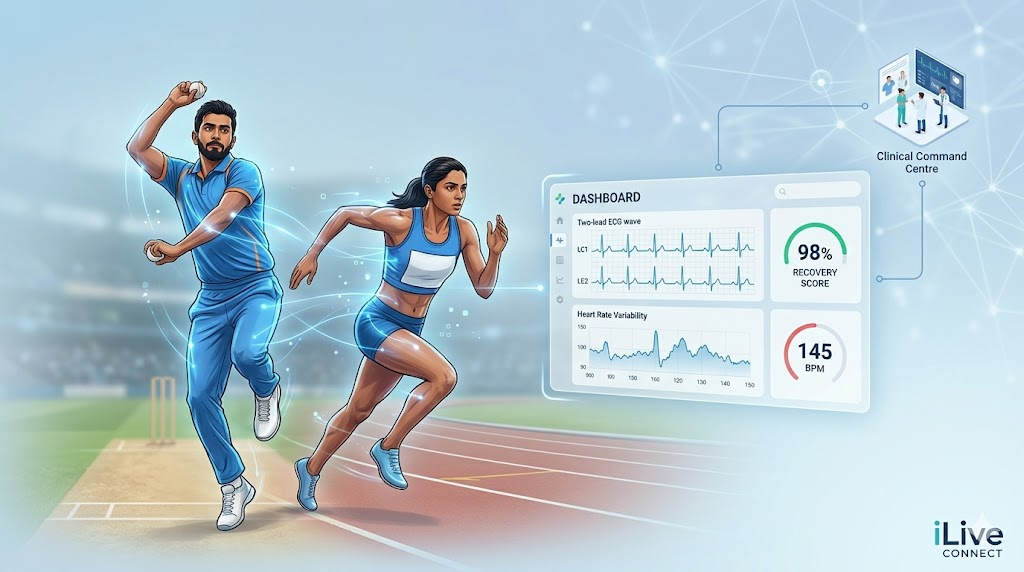
Top athletes now use medical-grade biosensors—like the FDA-approved patches from iLive Connect—that provide two-lead ECG and continuous respiratory rate. This allows coaches to monitor the “micro-rhythms” of the heart with the same accuracy as a hospital’s health monitoring system.
An athlete’s biggest fear is the “silent injury”—the strain that happens while they sleep. Unlike a smartwatch that simply logs sleep data, iLive Connect streams vitals to a 24/7 Clinical Command Centre.
If a fast bowler’s Heart Rate Variability (HRV) drops at 3 AM, signaling extreme fatigue or dehydration, our specialist doctors see it instantly. This “Virtual ICU” approach allows for immediate intervention, preventing a minor strain from becoming a six-month injury layoff.
Performance in 2026 is about the entire healthcare solution, not just the device. iLive Connect bridges the gap between training and medicine:
The Indian Premier League (IPL) is perhaps the most physically demanding tournament in the world. With constant travel, varying altitudes, and back-to-back matches, “Recovery” is the most important word in a cricketer’s vocabulary.
Top franchises are now integrating smart healthcare systems to monitor player workload. By using clinical-grade ecosystems, team physiotherapists can see exactly who is fit for the next match and who is at risk of a “fatigue-based” muscle tear. This level of wearable health monitoring is what keeps our stars on the field for the full two months of the season.
Whether you are an Olympic hopeful or a “corporate athlete” managing high stress, your body deserves more than “estimates.” The switch to clinical-grade ecosystems signifies a new era in Indian sports—an era where we don’t just “track” health; we protect it under professional medical guidance.
In the pursuit of the “next level,” don’t let a lifestyle gadget be your boundary. Upgrade to the clinical standard that the world’s best are now adopting.

March 25, 2026
March 12, 2026
March 18, 2026
January 12, 2026
February 25, 2026