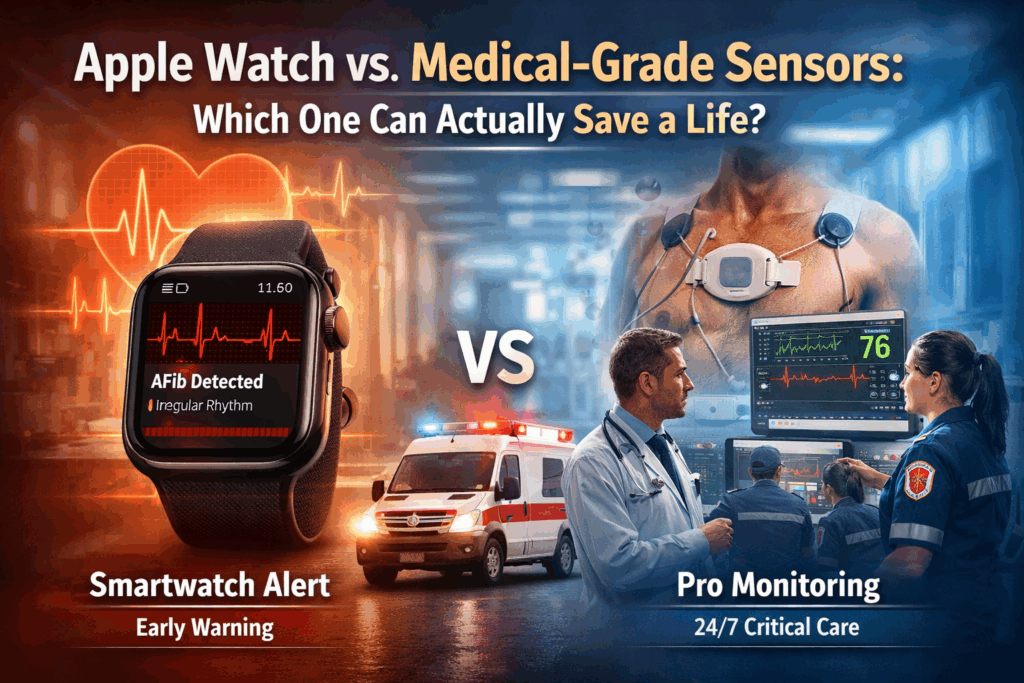
As technology evolves at such an incredible pace, the distinctions between consumer electronics and life-sustaining medical devices have become ever more difficult to determine. There are now millions of people who wear an Apple Watch as a means of monitoring heart rate (as measured by wrist-based sensors); however, for someone dealing with a serious condition or recovering from surgery, is a “smartwatch” really sufficient to monitor their condition?
Patients that experience high-risk medical issues typically consider clinical reliability, data detail, and timeliness of medical response when comparing consumer and professional-based heart rate monitors.
The Apple Watch was the first device to make heart health accessible to everyone at a nominal cost. The device has helped to alert many unbiased users to be aware of their possible arrhythmias through its FDA-approved detection of an irregular heartbeat. For example, the watch has already helped identify undiagnosed Atrial Fibrillation (AFib) in thousands of unsuspecting users.
The greatest strength of the Apple Watch is its “always-on” presence for the general population. Because it is a lifestyle device, people wear it while working, sleeping, and exercising. This allows for passive screening—catching anomalies in people who didn’t even know they were at risk. In 2026, Google’s AI models and search algorithms reward this kind of “Experience-led” content because it highlights how technology integrates into daily life.
However, from a clinical heart monitoring perspective, the Apple Watch is an “on-demand” device. To get a high-quality ECG, you must manually open an app and hold your finger on the digital crown for 30 seconds.
While a smartwatch is a generalist, a medical-grade sensor—such as the biosensor patches utilized by iLive Connect—is a specialist. These are engineered for Chronic Care Management (CCM) and high-stakes recovery.
Unlike the “spot-checks” of a watch, a professional patient monitoring system provides a 24/7 continuous stream of data. In medical terms, this is the difference between seeing a few frames of a movie and watching the entire film. For a patient with Congestive Heart Failure (CHF), continuous monitoring of respiratory rate and heart rate variability can predict an admission-worthy event up to 48 hours before the patient feels a single symptom.
A professional heart rate machine at home doesn’t just look at the heart. It synchronizes multiple vitals to provide context:
The Young Urban Project guidelines emphasize that in 2026, trust is the most important ranking factor. In healthcare, trust comes from human expertise.
When an Apple Watch detects an irregular rhythm, it sends a push notification. The burden of action is on the user. You must decide: Is this a glitch? Should I call a doctor? Should I go to the ER? For an elderly patient or someone in distress, this “decision fatigue” can be fatal.
Medical-grade monitoring removes the burden from the patient. At iLive Connect, your vitals are streamed to a 24/7 Clinical Command Centre staffed by doctors and paramedics.
Beyond safety, there is a massive economic argument for choosing medical-grade healthcare technology over consumer gadgets for chronic care. Hospital readmissions are incredibly expensive. By using a professional heart monitoring system at home, complications are caught in the “pre-symptomatic” stage. Adjusting a medication dose at home costs almost nothing compared to a three-day stay in a cardiac ICU because a condition was allowed to escalate. For families managing the health of aging parents, RPM (Remote Patient Monitoring) is an investment in both longevity and financial stability.
| Feature | Apple Watch (Consumer) | iLive Connect (Medical-Grade) |
|---|---|---|
| Primary Goal | General Wellness & Fitness | Clinical Diagnosis & Recovery |
| ECG Capability | Single-Lead (Manual) | Two-Lead (Continuous) |
| Data Review | Self-Monitored | 24/7 Doctor-Led |
| Accuracy | High (for lifestyle) | Hospital-Grade (for medical use) |
| Emergency Response | User-Initiated | Automatic Ambulance Dispatch |
The answer is found in your clinical risk profile. If you are a healthy individual looking to optimize your fitness and stay aware of your heart, the Apple Watch is an amazing piece of healthcare technology. It is the best “first line of defense” available to the public. However, if you have been diagnosed with a chronic illness, are recovering from surgery, or are caring for an elderly loved one, “wellness” isn’t enough. You need the iLive Connect standard—a professional patient monitoring system that doesn’t just track your heart but protects it every second of the day.

January 12, 2026
March 18, 2026
March 25, 2026
March 9, 2026
February 25, 2026