When an older parent lives alone or in another city, a daily phone call can offer reassurance, but it cannot show what happens between conversations. Someone may genuinely feel fine while their health readings change during the day.
This is where continuous health monitoring can add another layer of visibility. Connected medical devices can collect selected health information over time, while AI-enabled systems can help identify changes that may need a closer look.
But the value does not lie in the alert alone. What matters is what happens after it: clinical review, context and appropriate action.
Routine health checks provide important information, but they only capture specific points in time. Continuous monitoring can provide a view of selected health parameters as they change during everyday life.
Depending on the monitoring system, this may include heart rate, oxygen saturation, blood pressure variations, breathing patterns and ECG trends.
For an older adult living independently, this can give healthcare teams another source of information between consultations. For their family, especially when they live in another city or country, it can provide visibility that a phone call cannot.
The purpose is not to watch every health reading throughout the day. It is to have relevant information available when a change needs to be reviewed.
Continuous monitoring can generate a large amount of information. A clinical team cannot treat every reading as equally important, which is where AI-enabled analysis can support the monitoring process.
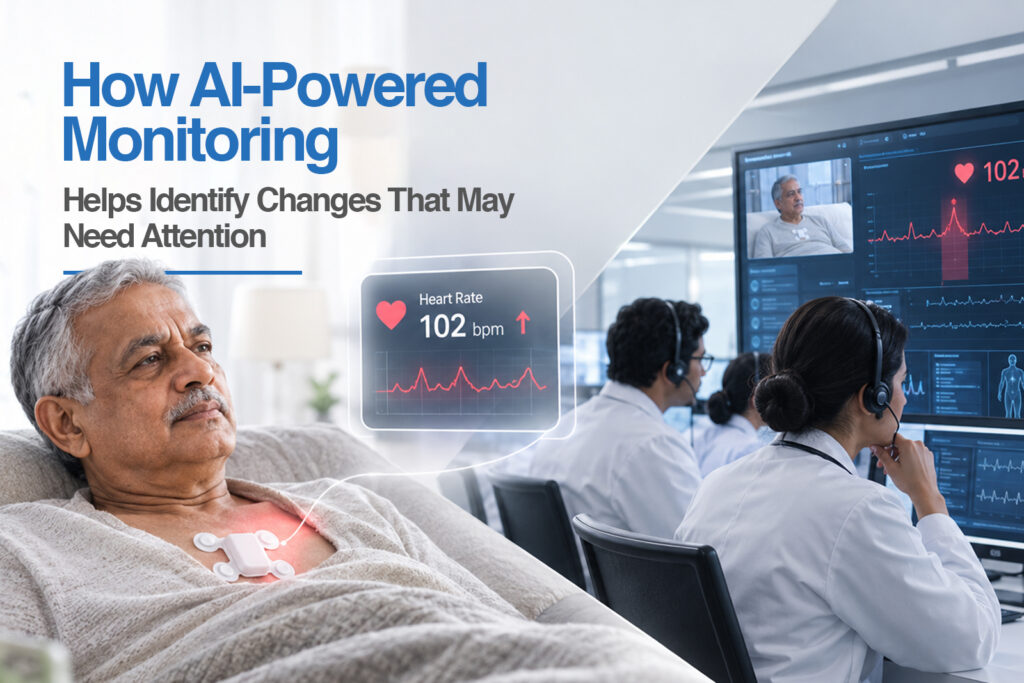
Connected medical or biosensor devices collect selected health parameters over time. Instead of relying only on occasional measurements, healthcare teams can have access to a more continuous stream of relevant information.
This creates the foundation for the rest of the process. Without ongoing information, there is little opportunity to identify how readings are changing over time.
AI-enabled systems can analyse incoming information and flag selected readings or patterns based on how the system is designed.
For example, one unusual reading may not necessarily mean that anything is wrong. A series of changes may provide a reason for a healthcare professional to take a closer look.
This is where AI healthcare monitoring can be useful. AI helps bring relevant information forward for attention. It does not independently diagnose a condition or decide what medical action should follow.
An alert needs context.
Doctors or trained healthcare professionals can review the flagged information alongside previous readings and other available health details. They can then consider whether the situation calls for continued observation, contact with the person or family, a consultation or another appropriate response.
This human review is important because an automated system may not have access to everything that matters when assessing someone’s situation.
The World Health Organization’s guidance on AI in health highlights human autonomy, safety, transparency and accountability as important principles for the use of AI in healthcare. The FDA’s current guidance on clinical decision-support software also distinguishes software functions according to their intended use.
The process should not end with a notification.
Depending on the clinical review, the next step may simply be continued observation. In other situations, the healthcare team may contact the person or family, facilitate a video consultation or coordinate appropriate medical support.
This creates a more useful pathway than leaving families with an alert that they have to interpret themselves.
Distance can create a practical gap in elder care. Regular calls and check-ins can provide reassurance, but they do not offer continuous visibility into changes that may occur between conversations.
For older adults living independently, continuous monitoring can help bridge part of this gap by keeping selected health information available for review throughout the day. If the system flags a change, the information does not have to be interpreted by family members on their own.
With iLive Connect, the available readings can be reviewed by doctors and trained healthcare professionals through its constantly-workingClinical Command Centre. Where appropriate, the clinical team can contact the person or family, facilitate a video consultation or coordinate further medical support.
This creates a more connected approach to remote health monitoring for elder care. Families remain informed without having to constantly monitor health readings themselves, while the person being monitored can continue with everyday life without turning routine activities into a series of health checks.
The benefit is not simply knowing more about a loved one’s health. It is having a clinical process in place to help determine when a change may require attention.
A monitoring device can collect health information. An alert system can bring certain readings to attention. iLive Connect brings these elements together with 24/7 doctor-led clinical oversight.
Its connected medical and biosensor devices continuously monitor selected health parameters. AI-enabled analysis can identify changes for review, while the round-the-clock Clinical Command Centre provides a team of doctors and trained healthcare professionals to assess the available information.
Where appropriate, the clinical team can contact the person or family, facilitate a video consultation or coordinate further medical support.
That means the process does not stop at:
“A change has been detected.”
It continues to:
“A change has been flagged, the available information has been reviewed, and the appropriate next step can be considered.”
For families caring for an older parent from a distance, this clinical layer is an important part of the experience. They are not simply receiving health data or trying to interpret an automated notification on their own.
Continuous heart health monitoring can make selected health information visible between routine consultations and family check-ins. AI-enabled analysis can help bring certain patterns forward for review rather than waiting for every change to become the subject of a scheduled interaction.
This is where predictive heart healthcare can have a practical role. AI-based systems may identify patterns in available heart health data that meet certain criteria and flag them for review. They cannot know with certainty what will happen next, and an alert does not automatically mean that a health problem is developing.
The value is in creating an opportunity for relevant information to reach the people who can assess it.
For an older adult, that can mean continuing with everyday life without having to manage every reading themselves. For a family member living far away, it can mean having a clinical health monitoring process in place rather than relying only on a daily “I’m fine” call.
The real value of AI-powered monitoring is not the notification itself. It is the process that follows.
Health information is collected continuously. AI-enabled analysis can bring selected changes forward. Healthcare professionals review the available information, and appropriate action can follow when needed.
iLive Connect brings this process together through connected medical devices, AI-enabled monitoring and a 24/7 Clinical Command Centre.
For families caring for older loved ones from a distance, that means remote health monitoring can involve more than simply seeing health data. It can connect continuous visibility with doctor-led review and support, while allowing everyday life to continue.